
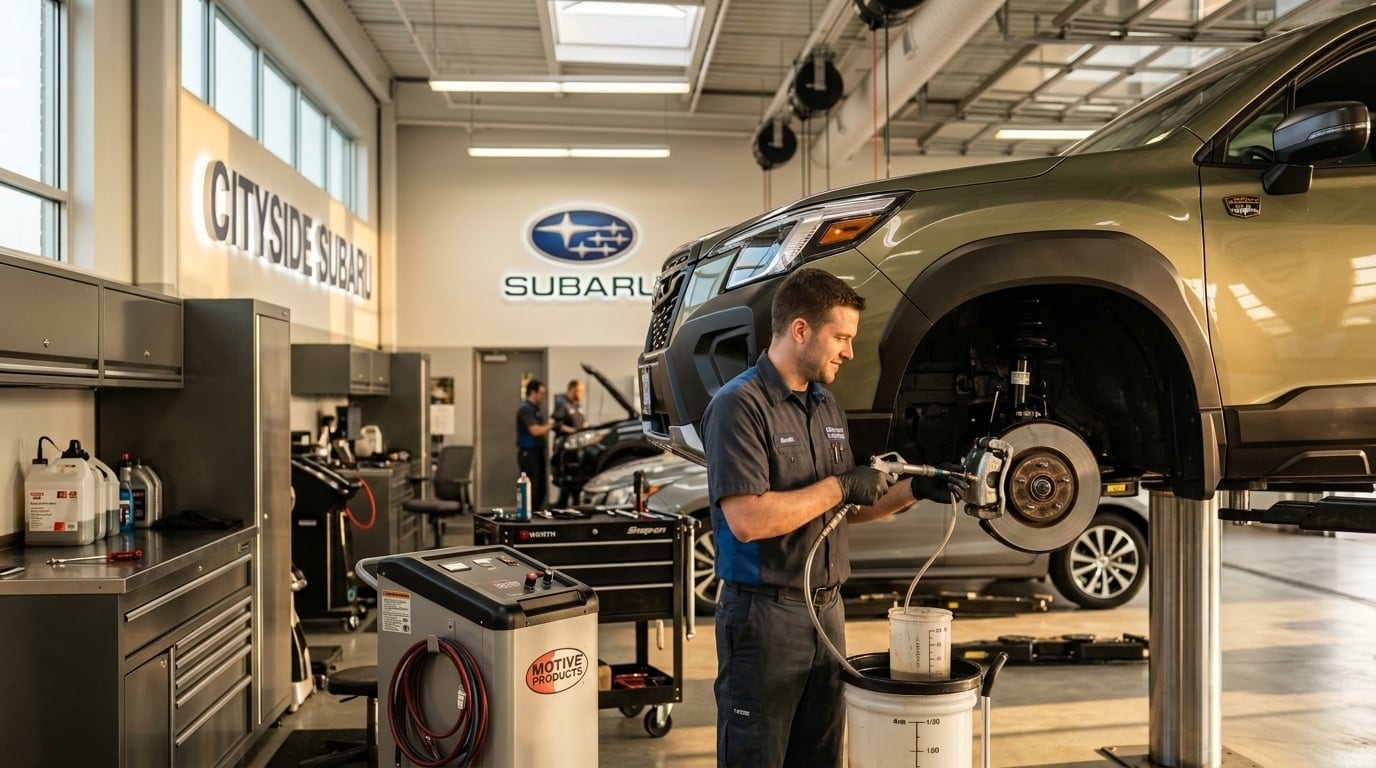
Every late-model Subaru requires a structured fluid maintenance schedule anchored by engine oil and filter changes every 6,000 miles or 6 months. Complete ownership care also includes replacing DOT 3 brake fluid every 30,000 miles or 3 years, evaluating Lineartronic CVT fluid at 60,000 miles for severe-duty operation, and checking factory-filled Subaru Super Coolant, which reaches its initial replacement threshold at 137,500 miles or 11 years. Routine multi-point inspections ensure essential operating fluids remain clean and filled to factory specifications.
Subaru vehicles utilize a unique mechanical layout featuring a horizontal Boxer engine paired with Symmetric All-Wheel Drive. This design places specific demands on internal lubricants and hydraulic systems. Heat, friction, and environmental exposure gradually degrade fluid chemistry over time. Maintaining these fluids according to factory recommendations protects internal engine bearings, transmission control valves, and all-wheel-drive differential gears.
Routine fluid management is the cornerstone of vehicle longevity. During regular driving, internal fluids absorb ambient moisture, combustion byproducts, and microscopic wear particles. Leaving degraded fluids in system reservoirs can cause internal corrosion, premature seal wear, and reduced hydraulic efficiency. Drivers seeking certified vehicle care can easily reach our Belmont service facility or speak directly with our service team at (866) 978-3793 to confirm factory service intervals for their specific model.
Table of Contents
- What Types of OEM Fluids Does Your Subaru Need and Which Require Attention First?
- Are Fluid Top-Ups Included in Standard Subaru Oil Change Packages?
- How Often Should Subaru Brake Fluid Be Flushed and What Are the Warning Signs?
- How Is Lineartronic CVT Fluid Checked and Maintained in a Forester or Outback?
- Why Choose Genuine OEM Subaru Fluids for Local Service?
- Common Questions About Subaru Fluid Maintenance and Service Intervals
- Schedule Your Next Subaru Fluid Service at Cityside Subaru
What Types of OEM Fluids Does Your Subaru Need and Which Require Attention First?
Subaru vehicles rely on five primary specialized fluid formulations, with 0W-20 synthetic oil and DOT 3 brake fluid requiring the most immediate and recurring maintenance attention. Engine oil protects high-speed internal components, while brake fluid provides the hydraulic pressure needed for responsive stopping power. Gear oils, transmission fluids, and engine coolants operate on longer service lifespans but remain critical to mechanical dependability.
Each fluid type serves a distinct technical function across the powertrain:
- Engine Oil: Late-model 2.5L non-turbo engines utilize 0W-20 synthetic oil to maximize fuel efficiency and cold-start lubrication, while turbocharged variants often require 5W-30 synthetic oil.
- Brake Fluid: Glycol-based DOT 3 brake fluid transfers pedal pressure to the brake calipers while resisting high temperatures generated during heavy braking.
- Coolant: Blue Subaru Super Coolant is an ethylene glycol-based Phosphate-enhanced Organic Acid Technology (POAT) pre-mixed formula engineered specifically for aluminum engine blocks.
- Transmission Fluid: Specialized Lineartronic CVT fluid (CV-30 or High Torque formula) provides precise friction characteristics for continuous chain-and-pulley engagement.
- Differential Gear Oil: Universal 75W-90 gear oil lubricates front and rear differential gear sets within the all-wheel-drive system.
Engine oil breaks down faster than any other vehicle fluid due to intense thermal cycling and combustion exposure. Replacing oil every 6,000 miles or 6 months prevents harmful sludge accumulation. Brake fluid requires the second highest priority, needing a complete system flush every 30,000 miles or 3 years. Drivers navigating daily stop-and-go commuting through Brookline expose their vehicle's braking and engine components to frequent thermal cycles, making adherence to these early maintenance milestones vital for consistent daily performance.
Are Fluid Top-Ups Included in Standard Subaru Oil Change Packages?
Standard Subaru synthetic oil change services include complimentary fluid level inspections and routine top-ups for essential reservoirs as part of a comprehensive multi-point health check. Technicians verify levels for windshield washer fluid, engine coolant expansion tanks, power steering reservoirs where applicable, and brake fluid reservoirs, replenishing low levels with genuine OEM fluids.
During a standard maintenance visit, factory-trained technicians inspect fluid clarity, check for external system leaks, and fill reservoirs to proper operating indicators. Recharging washer fluid ensures clear visibility, while checking coolant expansion tanks helps maintain proper cooling system pressure.
However, fluid top-ups are designed to maintain operational volume between complete service intervals and should never replace scheduled fluid flushes. Adding fresh fluid to an aging reservoir dilutes chemical degradation slightly but does not remove suspended contaminants, trapped atmospheric moisture, or oxidized particles. While a top-up keeps fluid volume within safe operating margins, complete fluid flushes remain necessary when mileage or time limits are reached.
How Often Should Subaru Brake Fluid Be Flushed and What Are the Warning Signs?
Subaru guidelines specify a full brake fluid flush every 30,000 miles or 36 months because brake fluid naturally attracts and absorbs atmospheric moisture through reservoir vents and rubber seals. Fresh DOT 3 brake fluid features a dry boiling point of 401 degrees Fahrenheit, but absorbed water can lower its wet boiling point to 284 degrees Fahrenheit, dramatically reducing heat resistance under heavy braking conditions.
Moisture accumulation creates serious operating hazards under severe thermal stress. When brake calipers heat up during prolonged stopping, water contamination inside the fluid lines can vaporize into steam. Because steam compresses while liquid does not, contaminated fluid leads to a soft pedal sensation and longer stopping distances.
Common indicators that a vehicle requires an immediate brake fluid flush include:
- A spongy, soft, or sinking brake pedal feel during hard application.
- Dark brown or murky discoloration visible inside the plastic brake fluid reservoir.
- Reduced stopping responsiveness or increased pedal effort required to slow the vehicle.
- Persistent moisture contamination verified during a routine multi-point service check.
Subaru crossover owners traveling near the damp banks of the Mystic River in Medford often encounter humid coastal weather patterns that accelerate moisture ingress into brake hydraulic lines. Performing a complete fluid flush flushes out degraded, water-saturated fluid and replaces it with fresh, high-boiling-point fluid, restoring firm pedal feel and reliable stopping capability.
How Is Lineartronic CVT Fluid Checked and Maintained in a Forester or Outback?
Checking the fluid level in a Subaru Lineartronic CVT requires specialized diagnostic equipment and elevated vehicle positioning because modern Subaru transmissions do not utilize a traditional engine-bay dipstick. Servicing the transmission involves checking fluid expansion via a bottom overflow plug while monitoring live fluid temperature data through an electronic scan tool.
When owners inquire about checking transmission fluid levels during service appointments, technicians explain that the vehicle must be lifted perfectly level on a shop hoist. The engine is started, and technicians monitor the transmission fluid temperature until it reaches an exact window—typically between 95 and 113 degrees Fahrenheit—before removing the fill plug to verify proper overflow.
Subaru factory schedules list Lineartronic CVT fluid for routine inspection every 6,000 miles, with a complete fluid drain-and-fill specified at 60,000 miles for severe-duty driving conditions. Severe driving includes regular trailer towing, vehicle operation in mountainous terrain, or repeated short-distance city driving. Maintaining clean transmission fluid prevents heat-induced shear breakdown, protecting the internal chain and pulley mechanisms found across the 2026 Subaru Outback, Forester, and Crosstrek lineup.
Why Choose Genuine OEM Subaru Fluids for Local Service?
Genuine OEM Subaru fluids are formulated specifically to match the internal metallurgy, synthetic gasket materials, and operating pressures of Boxer engines and Symmetric AWD systems. Using non-approved aftermarket products can compromise internal component seals, degrade thermal protection, and lead to premature mechanical wear.
Generic fluids often rely on multi-vehicle additive packages that fail to deliver precise engineering tolerances. For instance, mixing standard green conventional antifreeze into a cooling system designed for blue Subaru Super Coolant disrupts the Phosphate-enhanced Organic Acid Technology, accelerating internal aluminum corrosion. Similarly, generic transmission fluids may lack the exact friction coefficients needed for chain-driven Lineartronic CVT assemblies, increasing internal slip and operating temperatures.
Choosing factory-approved fluids delivers clear mechanical advantages:
- Formulated specifically for aluminum Boxer engine blocks and high-shear all-wheel-drive components.
- Maintains factory warranty coverage and long-term mechanical reliability standards.
- Prevents chemical incompatibility issues that deteriorate rubber seals and internal gaskets.
- Delivers exact thermal resistance matched to New England's extreme seasonal temperature swings.
Vehicle owners performing their own basic maintenance can easily order genuine Subaru parts online to guarantee component compatibility. Drivers planning their next shop visit can also explore current service and parts specials for valuable maintenance savings.
Common Questions About Subaru Fluid Maintenance and Service Intervals
What happens if standard green antifreeze is mixed with Subaru Super Coolant?
Mixing conventional green antifreeze with blue Subaru Super Coolant dilutes the specialized Phosphate-enhanced Organic Acid Technology (POAT) corrosion inhibitors. This chemical reaction weakens corrosion protection across aluminum cylinder heads and engine blocks, causing scale buildup and significantly shortening the coolant's effective service lifespan.
Why does Subaru CVT fluid require a specific OEM formulation?
Subaru Lineartronic CVT assemblies rely on metal chain-and-pulley friction to transfer engine torque. Genuine Subaru CV-30 and High Torque CVT fluids feature specialized viscosity index improvers and anti-wear additives designed to maintain grip under high clamp pressures without damaging internal hydraulic control valves.
Does cold winter weather affect Subaru fluid performance?
Severe sub-freezing winter temperatures increase fluid viscosity, making proper fluid selection essential. Using factory-recommended 0W-20 synthetic oil ensures rapid oil flow to critical engine bearings during cold starts, while fresh brake fluid prevents water contamination from freezing inside ABS hydraulic control valves.
How do technicians determine if differential gear oil needs replacement?
Technicians inspect differential gear oil during routine service by sampling fluid from the fill plug. They evaluate fluid clarity, dark oxidation, thermal breakdown odors, and metallic debris accumulation on magnetic drain plugs, recommending replacement when gear oil shows signs of severe shear degradation.
How long does a full fluid inspection and oil service take?
A standard oil change combined with a comprehensive multi-point fluid level and battery inspection typically takes under an hour when performed by factory-trained technicians. Drivers looking to maintain their vehicle's peak operating condition can convenient schedule your service appointment online to reserve a dedicated service slot.
Schedule Your Next Subaru Fluid Service at Cityside Subaru
Staying proactive with factory-recommended fluid maintenance is the most effective way to safeguard your vehicle's mechanical health, preserve engine efficiency, and maintain all-weather traction performance. Regular fluid inspections ensure your all-wheel-drive crossover remains reliable through every season and driving condition.
Our factory-trained technicians utilize specialized diagnostic tools, exact fluid temperature monitoring equipment, and genuine OEM Subaru formulations engineered specifically for your vehicle. Whether your car requires a 6,000-mile synthetic oil change, a 30,000-mile brake fluid flush, or a severe-duty CVT fluid inspection, our service team delivers trusted care customized to your driving habits.
Give our service department a quick call today at (866) 978-3793 or visit Cityside Subaru at 790 Pleasant St in Belmont to keep your vehicle running smoothly for years to come.
© 2026 Cityside Subaru. All rights reserved.