
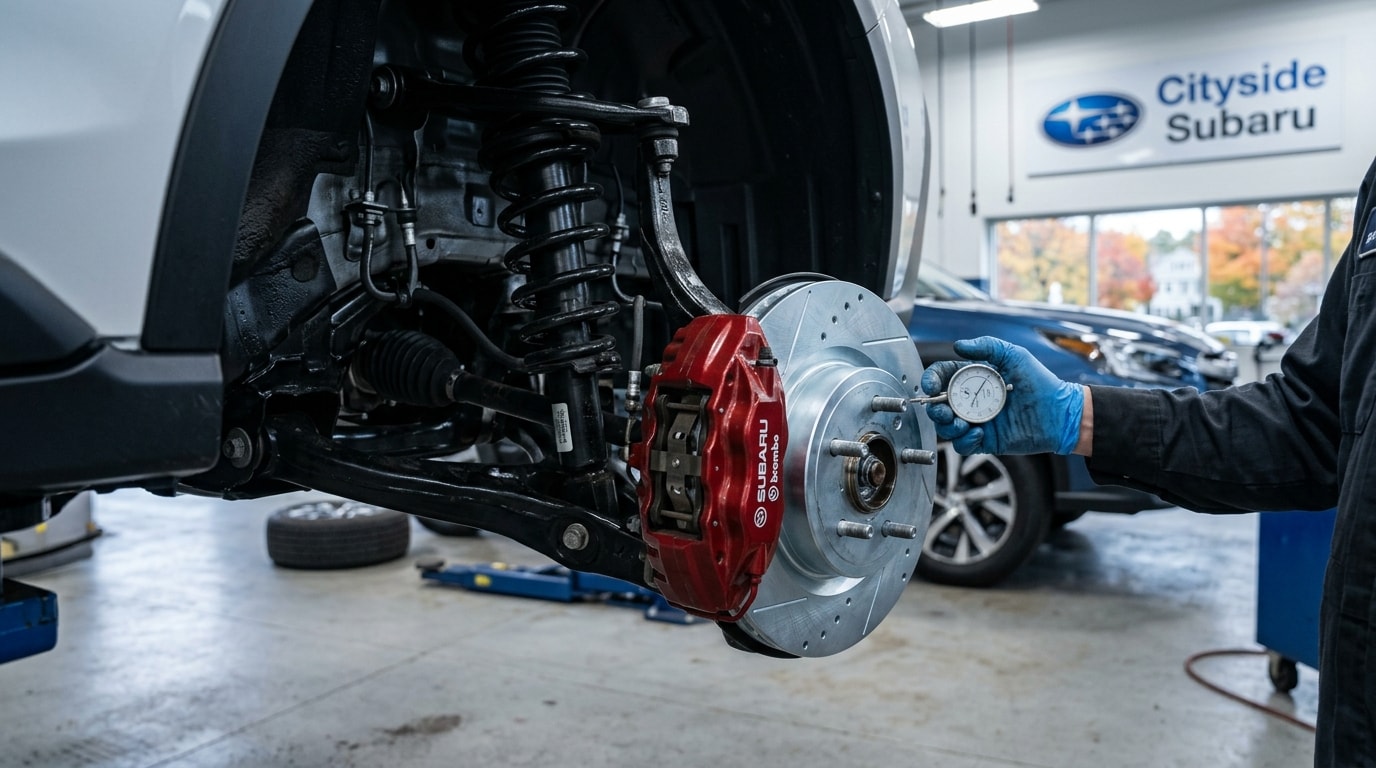
Essential Brake Maintenance for Your 2026 Subaru
Maintaining the stopping power of your vehicle is a fundamental aspect of ownership that directly impacts the safety of your daily travels through Medford. The braking system in a modern vehicle like the 2026 Subaru Outback or 2026 Subaru Forester is a sophisticated network of hydraulic and mechanical components designed to perform under the varied conditions of the Northeast. Because our region experiences heavy road-salt use during the winter, keeping these parts clean and well-lubricated is vital to preventing premature corrosion and ensuring consistent pedal response.
Our team of certified technicians specializes in the specific requirements of the Symmetrical All-Wheel Drive platform, which utilizes the braking system not just for stopping, but for traction management through the Active Torque Vectoring and EyeSight Driver Assist technology suites. When these systems detect a loss of grip or a potential collision, they rely on the integrity of your brake pads and calipers to intervene effectively. A standard inspection at our facility involves measuring pad thickness, checking for rotor scoring, and ensuring that brake lines are free from leaks or swelling.
If you have noticed a change in how your vehicle handles during a stop or if a dashboard warning light has appeared, addressing the issue promptly can prevent more extensive repairs to the rotors or master cylinder. You can reach our service department at (866) 978-3793 to discuss any specific symptoms you are experiencing. For those managing a busy professional schedule, we offer a convenient online service scheduler to help you secure a time that fits your day. If you prefer to speak with us in person or drop off your vehicle, you can find directions to our Belmont location right here on our website.
Table of Contents
- Optimal Service Intervals for the 2026 Forester and Outback
- Identifying Common Brake Wear Indicators and Grinding Noises
- Brake Fluid Flush Protocols and Long-Term Hydraulic Care
- Warranty Coverage and Wear Item Protection for New Subaru Models
- Performance Brake Upgrades and Genuine OEM Component Benefits
- Expert Brake Service Solutions for Greater Boston Drivers
- Quick Answers Regarding Subaru Brake Service
Optimal Service Intervals for the 2026 Forester and Outback
How often should you actually have your brakes checked? For the 2026 Subaru Forester, the manufacturer recommends a professional brake inspection every 12,000 miles or 12 months, whichever comes first. However, the stop-and-go nature of a commute into Boston often accelerates wear. In these high-frequency braking environments, we suggest a quick visual check of the pads and rotors every 6,000 miles, typically performed during a routine oil change and tire rotation. This proactive approach allows us to catch uneven wear patterns early, which can sometimes indicate a sticking caliper or a suspension alignment issue.
The 2026 Subaru Outback follows a similar maintenance schedule, with a comprehensive brake system review integrated into the 30,000-mile service interval. At this milestone, our technicians do more than just look at the pads; we evaluate the entire hydraulic system and the parking brake adjustment. For drivers who frequently use their vehicle for outdoor activities—such as hauling gear to the Middlesex Fells Reservation in Medford—the extra weight can increase the heat generated during braking. This thermal stress can lead to "glazing" on the pads, a condition where the friction material becomes hardened and less effective.
Regularly scheduled maintenance is the most effective way to ensure your Subaru Limited Warranty remains in good standing while maximizing the lifespan of your factory components. We frequently provide service and parts specials to help our local community maintain their vehicles according to these factory-recommended windows. By adhering to a consistent schedule, you ensure that your vehicle's safety systems, including the vehicle-to-vehicle front crash prevention 2.0, have the mechanical support they need to function at peak performance.
Identifying Common Brake Wear Indicators and Grinding Noises
Drivers often ask about the specific sounds a vehicle makes when the brakes are reaching the end of their service life. If you hear a high-pitched squealing or screeching sound while applying the brakes, this is often a deliberate design feature. Most Subaru brake pads are equipped with a small metal tab called a wear indicator. When the friction material wears down to a specific thickness—usually around 2 millimeters—this tab makes contact with the rotor to create a localized noise, alerting you that it is time for a replacement.
A grinding noise, however, represents a more urgent situation. This metallic "metal-on-metal" sound typically indicates that the brake pad material has been completely exhausted, leaving the steel backing plate to press directly against the brake rotor. Continuing to drive under these conditions will quickly damage the rotors, leading to deep grooves or "scoring" that often requires the rotors to be replaced rather than simply resurfaced. This not only compromises your safety by increasing stopping distances but also significantly increases the total cost of the repair.
Beyond noise, you should be mindful of physical feedback through the steering wheel or brake pedal. A distinct vibration or pulsation during braking often suggests that the brake rotors have developed "runout" or have become warped due to excessive heat. This is particularly common for larger vehicles like the 2026 Subaru Ascent, which carries more mass and generates more kinetic energy during deceleration. If the pedal feels "spongy" or sinks lower to the floor than usual, it may indicate air in the hydraulic lines or a failing seal within the system, both of which require immediate professional attention.
Brake Fluid Flush Protocols and Long-Term Hydraulic Care
While much of the focus remains on pads and rotors, the brake fluid is the lifeblood of your stopping system. Subaru recommends a complete brake fluid flush every 30,000 miles or 30 months for the 2026 model lineup. Brake fluid is hygroscopic, meaning it naturally absorbs moisture from the air over time. In the humid environment of Greater Boston, this moisture accumulation can lower the boiling point of the fluid, potentially leading to "brake fade" during prolonged downhill braking or in heavy traffic.
Moisture in the lines also poses a long-term threat to the internal metal components of the braking system. As water content increases, it can cause internal corrosion within the brake lines, calipers, and the expensive Anti-lock Braking System (ABS) control module. By performing a fluid exchange at the recommended intervals, we remove these contaminants and replace the old fluid with fresh, high-quality glycol-based fluid that meets the specific viscosity requirements for your vehicle’s hydraulic pump and actuators.
During a fluid service at our facility, we also "bleed" the system to ensure that no air bubbles are trapped in the lines. Even a tiny pocket of air can compress under pressure, leading to a soft pedal feel and reduced braking force. For those driving a 2026 Subaru Outback or 2026 Subaru Forester, maintaining clean fluid is especially important for the longevity of the EyeSight Driver Assist technology, which relies on rapid, precise hydraulic pressure changes to execute emergency braking maneuvers without driver input.
Warranty Coverage and Wear Item Protection for New Subaru Models
A significant benefit for owners of new 2026 models is the comprehensive nature of the Subaru Limited Warranty. While most manufacturers exclude "wear items" from their standard coverage, the 3-year / 36,000-mile basic warranty from Subaru actually includes coverage for brake pads and even wiper blades. This means that if your brake pads wear down to the service limit within that initial three-year window, the replacement cost may be covered, providing added peace of mind for your first few years of ownership.
It is important to distinguish this from the Powertrain Warranty, which lasts for 5 years / 60,000 miles. The powertrain coverage focuses on the engine, transmission, and all-wheel-drive system components, but does not extend to friction materials like brake pads once the initial 36,000-mile period has ended. Additionally, Subaru provides a corrosion coverage plan for 5 years / unlimited miles, which protects against rust perforation—a relevant consideration for those living near the coast or in areas where road salt is heavily applied.
To maintain these protections, we recommend keeping detailed records of all inspections and services performed. Using genuine components and having service performed by factory-trained technicians ensures that any potential warranty claims are processed smoothly. This coverage is a testament to the brand's confidence in its engineering and its commitment to supporting the families and professionals who rely on their vehicles for everything from school runs to weekend excursions.
Performance Brake Upgrades and Genuine OEM Component Benefits
For drivers looking to tailor their vehicle to specific driving demands, there are several performance-oriented options available. Some owners of the 2026 Subaru Forester or 2026 Subaru Outback choose to upgrade to high-performance ceramic brake pads. These components are designed to produce less dust and noise while offering improved thermal stability, which is a great fit for the frequent stop-and-go traffic found in Brookline. Others may opt for slotted rotors, which help dissipate heat and gasses more efficiently during heavy use, such as when navigating hilly terrain with a full load of passengers.
Despite the availability of aftermarket options, there are distinct advantages to using genuine OEM (Original Equipment Manufacturer) parts. These components are engineered specifically for the weight, master cylinder displacement, and electronic safety calibrations of your particular model. For instance, the brake pads used on a 2026 Subaru Ascent are specifically formulated to handle the higher GVWR (Gross Vehicle Weight Rating) of a seven-passenger SUV. Choosing the correct parts ensures that the EyeSight system can calculate stopping distances accurately based on the original factory specifications.
If you are considering an upgrade or simply need a standard replacement, our parts department can help you identify the exact components required for your vehicle. We maintain a comprehensive inventory of factory-authorized pads, rotors, and hardware kits to ensure a perfect fit every time. You can easily order genuine Subaru parts through our online portal to ensure your vehicle remains as reliable as the day you drove it home.
Expert Brake Service Solutions for Greater Boston Drivers
At Cityside Subaru, we understand that your vehicle is more than just a mode of transportation; it is a tool that supports your family's active lifestyle and your professional commitments. Whether you are navigating the historic, narrow streets of Newton or heading out for a weekend of skiing, your brakes are the most important safety feature on your vehicle. Our team is dedicated to providing transparent, expert care that respects your time and prioritizes your safety on the road.
We invite you to experience our community-focused approach to automotive service. From detailed multi-point inspections to complex hydraulic repairs, we utilize the latest diagnostic technology to keep your vehicle performing at its best. If you have any questions about your maintenance schedule or would like to have a technician evaluate a specific concern, please give us a quick call today. We are here to ensure that every journey you take is backed by the dependability and performance that the brand is known for.
For those ready to visit us, our service center is conveniently located to serve the surrounding neighborhoods. You can get easy-to-follow directions to our Belmont facility and see why so many local drivers trust us with their vehicle's long-term care. We look forward to helping you keep your Subaru running like new for many miles to come.
Quick Answers Regarding Subaru Brake Service
Q: Does the 2026 Subaru use ceramic or semi-metallic brake pads?
Most 2026 models, including the Forester and Outback, come equipped with ceramic-based brake pads from the factory. These are chosen because they offer a balance of strong stopping power, low noise, and minimal brake dust. Ceramic pads are also excellent at managing the heat generated during the frequent braking common in suburban environments like Newton.
Q: What is the minimum thickness for brake pads before they must be replaced?
We recommend replacing brake pads when the friction material reaches a thickness of 2 millimeters. While some pads may still function at this level, the risk of the wear indicator scratching the rotor or the pad material failing under high heat increases significantly. During a routine inspection, our technicians will provide you with a specific measurement so you can plan for future service.
Q: How long do factory brake pads typically last on a 2026 Subaru?
Under normal driving conditions, original equipment brake pads generally last between 30,000 and 70,000 miles. However, this range can vary based on your driving habits and environment. For example, a vehicle used primarily for highway commuting will see much longer pad life than one frequently driven in the heavy traffic of Brookline, where the brakes are applied more often.
Q: How do I check if my Subaru has any active brake-related recalls?
You can check for any open recalls by locating your 17-digit Vehicle Identification Number (VIN), which is found on your registration or the driver-side dashboard. You can enter this number on the official Subaru website or the NHTSA recall tool. If a recall is listed for your braking system, contact us immediately to have the repair performed at no cost to you.
Q: Is a brake fluid flush really necessary every 30,000 miles?
Yes, because brake fluid is designed to absorb moisture to protect the internal metal parts of your braking system from rust. Once the fluid reaches a certain moisture threshold, its performance degrades, and it can cause internal damage to the ABS and master cylinder. Replacing it every 30,000 miles is a cost-effective way to prevent very expensive hydraulic repairs later in the vehicle's life.
© 2026 Cityside Subaru. All rights reserved.