

What I've Learned About 2026 Subaru 12-Volt Battery Service
## The Vital Role of the 12-Volt Battery in Your Modern Subaru
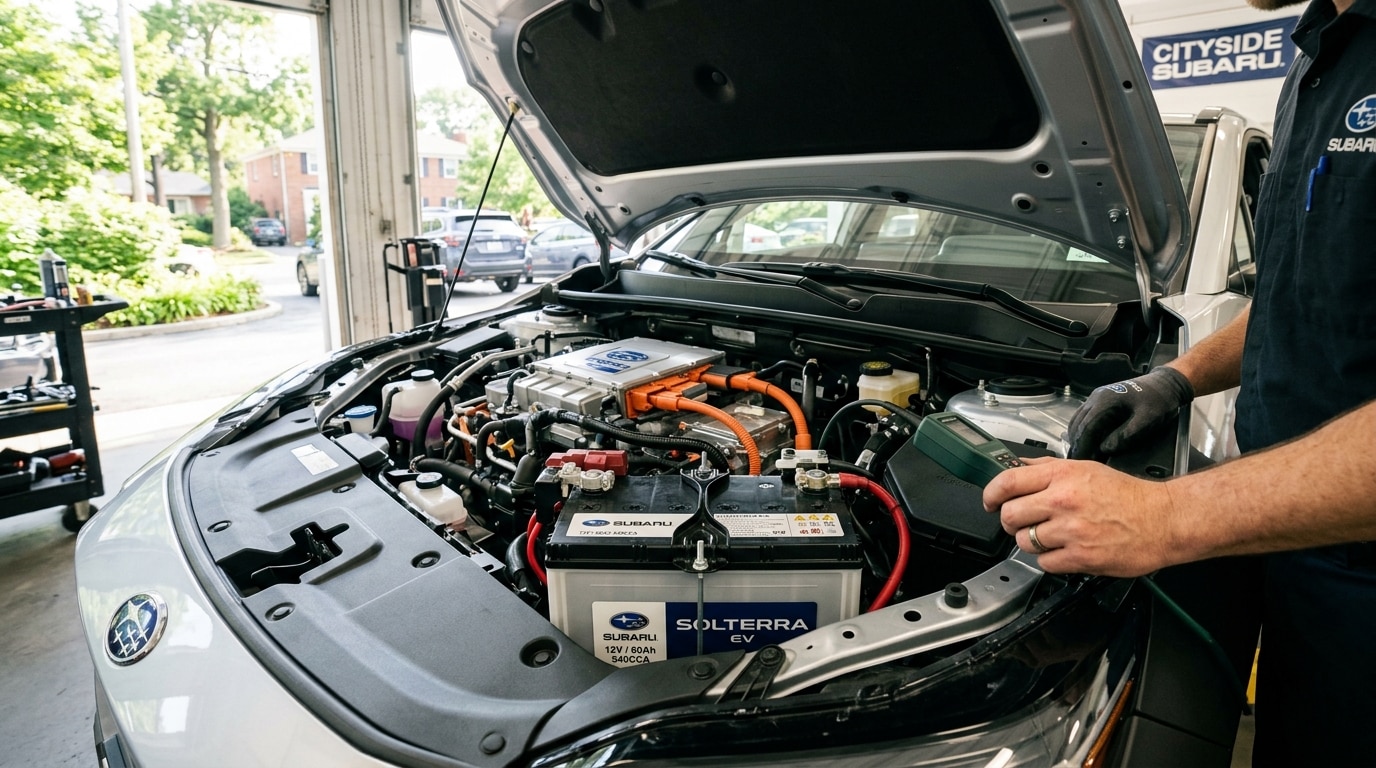
When I walk an owner through the engine bay of a 2026 Subaru Solterra, they are often surprised to find a traditional 12-volt battery sitting alongside the advanced electric drivetrain. While the High Voltage Battery handles the heavy lifting of propulsion, the smaller 12-volt unit is the unsung hero that manages the vehicle's "brain." It powers everything from the EyeSight Driver Assist sensors to the infotainment screen and the security system. Without a healthy 12-volt charge, your Subaru simply won't initiate the start sequence, regardless of how much energy is stored in the primary drive battery.
In my experience, the electrical demands on modern vehicles have increased exponentially. Your Subaru is constantly communicating with satellites and scanning for your key fob, which creates a small but steady "parasitic" draw on the 12-volt system. If you primarily use your vehicle for short trips around Medford, the alternator—or the DC-to-DC converter in electrified models—may not have enough time to fully replenish the energy used during the start cycle. This is why we recommend regular health checks to ensure your state of charge remains within the optimal range for reliable operation.
If you ever find yourself with a vehicle that won't turn over in your driveway, you can reach out to Subaru Roadside Assistance: 1-800-261-2155 for immediate support. Our team is also available if you need to give us a call at (866) 978-3793 to discuss any flickering lights or slow cranking you've noticed lately. If you're nearby, you can find our service center location on Pleasant Street for a quick diagnostic test.
Table of Contents
- Understanding the Advanced Battery Technology in 2026 Subaru Models
- How Long Your Factory Subaru Battery Will Last in New England Winters
- Warranty Coverage and Peace of Mind for Your Subaru Electrical System
- Managing the Auto Start-Stop System and Battery Longevity
- Safe Battery Maintenance: Terminal Disconnection and Essential Tools
Understanding the Advanced Battery Technology in 2026 Subaru Models
The question I get most often from tech-savvy drivers is whether they can just swap in any off-the-shelf battery from a big-box store. For the 2026 lineup, the answer is usually a firm no. Most modern Subaru models utilize either Enhanced Flooded Batteries (EFB) or Absorbent Glass Mat (AGM) technology. These aren't your standard lead-acid batteries; they are specifically engineered to handle the high-cycle demands of the Auto Start-Stop system and the constant data processing required by the vehicle's safety suites.
Using a standard battery in a system designed for an EFB often leads to premature failure, sometimes in as little as six months. The charging logic in your Subaru's computer is calibrated for the specific internal resistance and chemistry of the factory-spec unit. When we perform annual battery health checks, we use specialized diagnostic equipment to measure individual cell voltages and state of health, ensuring the battery can still meet the 620 to 750 CCA (Cold Cranking Amps) required for your specific engine and climate package.
For those who prefer to handle minor maintenance themselves, it is critical to use the correct Group 35 battery or the specific size listed in your owner's manual. You can order genuine Subaru parts directly through our department to ensure the replacement matches the original factory specifications. This ensures that your electrical system remains stable and that your EyeSight cameras receive the consistent voltage they need to function accurately.
How Long Your Factory Subaru Battery Will Last in New England Winters
New England winters are notoriously difficult on chemical energy storage, and the 12-volt battery is often the first component to feel the bite of a cold snap. While a factory battery typically lasts between 3 to 5 years, the prolonged sub-freezing temperatures we see can accelerate the degradation of the internal plates. Cold weather slows down the chemical reactions inside the battery while simultaneously thickening the engine oil, which means the battery has to work twice as hard to start the car exactly when it is at its weakest.
I often tell our neighbors in Brookline that the way you drive in the winter matters just as much as the temperature. If your daily routine involves short commutes where the seat heaters, defrosters, and wipers are all running at once, the battery may never reach a full state of charge. Over time, this leads to "acid stratification," where the active materials in the battery settle and harden, permanently reducing its capacity. For 2026 Solterra owners, utilizing the manually select battery preconditioning feature via the touchscreen can help optimize the 12-volt system's health by managing the thermal environment of the entire vehicle.
To help stay ahead of the weather, we suggest checking our current maintenance and parts coupons before the first deep freeze hits. A proactive test in October can save you from a "no-start" situation in January. We look for signs of terminal corrosion or a bulging case, both of which are indicators that the battery is struggling to keep up with the local climate's demands.
Warranty Coverage and Peace of Mind for Your Subaru Electrical System
One of the most reassuring aspects of owning a new vehicle is the Subaru New Car Limited Warranty. For the 2026 models, the 12-volt battery is typically covered under the basic 3 years / 36,000 miles term. This means if your battery is found to be defective—meaning it can no longer hold a charge due to a manufacturing flaw rather than simple wear and tear—Subaru will provide a free replacement. This is separate from the powertrain 5 years / 60,000 miles coverage, which focuses on the engine and transmission components.
For those driving the electrified Solterra, the coverage is even more robust regarding the propulsion system. The High Voltage Battery & Electric Drive Unit Limited Warranty extends for 8 years or 100,000 miles. However, it is important to remember that the 12-volt battery remains on the standard 3-year cycle. I've seen a few instances where owners assume the long-term EV battery warranty covers the smaller accessory battery, so keeping that distinction in mind is helpful for planning your long-term maintenance budget.
We also prioritize transparency when it comes to corrosion 5 years / unlimited miles coverage. In our salt-belt region, road salt can occasionally find its way into the engine bay, leading to terminal oxidation. While the warranty covers defects, keeping your battery terminals clean is a part of standard owner maintenance. If we notice excessive buildup during a routine oil change, we'll clean and protect the terminals to prevent a high-resistance connection that could mimic a failing battery.
Managing the Auto Start-Stop System and Battery Longevity
The Auto Start-Stop system is a frequent topic of conversation in our service drive, as it is one of the most significant stressors on a modern 12-volt battery. This system is designed to reduce emissions and improve fuel economy by shutting the engine down at red lights and stop signs. While the EFB in your Subaru is built to handle thousands of these cycles, the frequent restarting does place a higher load on the electrical system than older vehicle designs ever faced.
Many drivers ask if they should disable Auto Start-Stop to save their battery. While you can manually turn the system off using the vehicle's touchscreen menu, it will default back to 'On' every time you restart the car. From a service perspective, the system is highly intelligent; if the 12-volt battery's state of charge is too low, or if the cabin's climate control demands are too high, the computer will automatically inhibit the stop function to protect the battery.
If you find that your Auto Start-Stop is rarely engaging, it is actually a great early warning sign. It often means the battery's health is dipping just enough that the car is prioritizing charging over fuel savings. Instead of trying to bypass the system, we recommend bringing the vehicle in for a diagnostic. Often, a simple deep-cycle charge using our professional equipment can restore the battery to peak performance, allowing the fuel-saving features to work as intended without risking a dead battery.
Safe Battery Maintenance: Terminal Disconnection and Essential Tools
If you are a DIY enthusiast in Newton looking to perform your own electrical work, there is a specific order of operations you must follow to protect your Subaru's sensitive electronics. Before any service work, the best practice is to disconnect both the 12 V battery and the high-voltage battery service disconnect on electrified models. When working strictly with the 12-volt battery, you must always disconnect the negative terminal first. This prevents accidental short circuits if your wrench touches a metal part of the frame while loosening the positive terminal.
The battery terminals on a 2026 Subaru are designed for a tight, secure fit to handle the vibrations of Symmetrical All-Wheel Drive travel. Occasionally, the cable ends can become stuck due to heat cycles or minor oxidation. In these cases, a terminal puller may be needed to remove the cable safely without prying against the battery casing, which could cause internal damage. A simple 10mm wrench is the standard tool for the terminal nuts, but the puller ensures you don't stress the lead posts.
If you aren't comfortable working around high-voltage systems or sensitive computer modules, it is always safer to let a professional handle it. You can easily schedule a service visit online to have one of our certified technicians perform the replacement and reset the vehicle's battery sensor. If you need help finding us, you can get directions to our shop or give our service desk (866) 978-3793 for a quick estimate on labor and parts. We make sure the new battery is properly registered with the vehicle's charging system so you can drive away with total confidence.
© 2026 Cityside Subaru. All rights reserved.