
Your daily drive requires absolute confidence in your vehicle's ability to stop quickly and smoothly. For drivers navigating the heavy stop-and-go traffic along the Interstate 93 corridor near Medford, the braking system of the redesigned crossover is the most critical safety component on the vehicle. The demanding driving conditions of Greater Boston, characterized by rapid temperature swings and heavy winter road-salt use, place immense stress on brake friction materials. Ensuring that your stopping system remains in peak operating condition is vital for protecting your family and maintaining the engineered safety of your vehicle.
At Cityside Subaru, we focus on preserving the precise stopping performance of your vehicle through specialized, factory-certified maintenance. The updated chassis design of the redesigned crossover features advanced electronic integration that requires specialized diagnostic tools and training to service correctly. If you notice a change in pedal feel or hear unusual noises during your morning commute, you can use our convenient online scheduling tool to book a professional inspection.
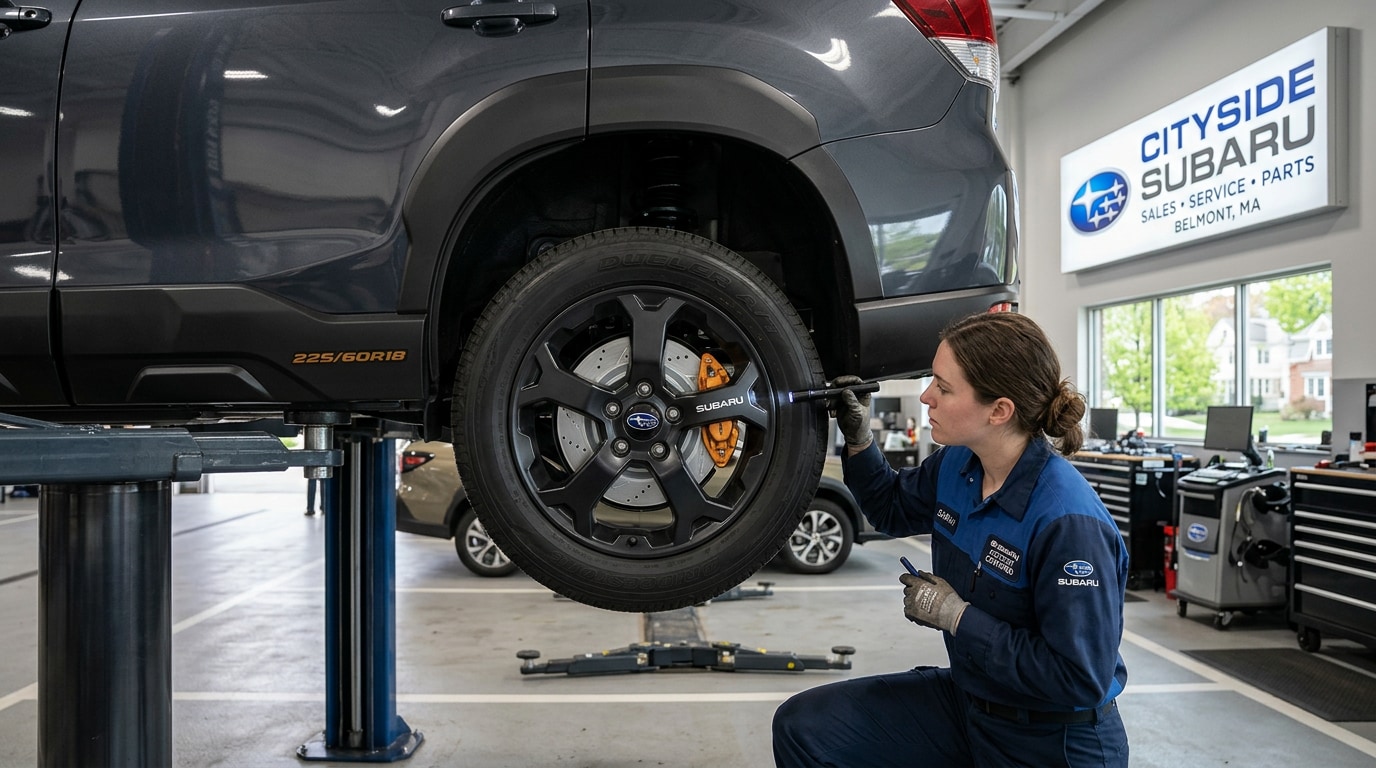
Regular maintenance not only ensures maximum stopping power but also prevents minor wear from developing into costly component failures. When you bring your vehicle to our facility at 790 Pleasant St, Belmont, MA 02478, our factory-trained technicians will perform a comprehensive multi-point inspection of your entire stopping system. To find the most direct route to our service bays, you can easily get directions to our dealership online. We recommend checking our current promotional maintenance offers before your visit to take advantage of seasonal savings on essential safety services. For immediate assistance or to speak directly with a service advisor about your vehicle's performance, please give our team a quick call.
Table of Contents
- Inside the Engineering: 2026 Subaru Forester Braking System Technical Specifications
- Expected Lifespan: How Many Miles Do Original Subaru Forester Brake Pads Last?
- Recognizing the Warning Signs That Your Forester Brakes Need Professional Service
- The Logistics of Stopping: Brake Service Costs and DIY Considerations
- Common Questions About Servicing Your Subaru Forester Braking System
- Schedule Expert Brake Care and OEM Parts Service at Cityside Subaru
Inside the Engineering: 2026 Subaru Forester Braking System Technical Specifications
The stopping hardware of the redesigned crossover is engineered to provide consistent performance across diverse driving environments. Every 2026 Subaru Forester in Boston comes standard with a sophisticated 4-wheel disc braking system featuring ventilated front and rear rotors. On the 2026 Subaru Forester Sport, the front brakes utilize high-capacity dual-piston calipers, while the rear wheels are equipped with single-piston calipers. This hydraulic setup is managed by a standard 4-channel, 4-sensor Anti-lock Brake System (ABS) and Electronic Brake-force Distribution, which dynamically balances hydraulic pressure between the front and rear axles based on vehicle load and deceleration rates.
A significant advancement for this model year is the integration of an electric brake booster. This technology replaces traditional vacuum-assist systems, allowing the vehicle to build hydraulic pressure more rapidly and precisely. The primary technical benefit of this change is how it enhances the standard EyeSight Driver Assist Technology. Because the electric booster can actuate the brakes electronically with greater speed, the pre-collision automatic braking features can intervene more smoothly and effectively in emergency situations.
Additionally, the braking system features a standard Electronic Parking Brake with Auto Vehicle Hold. This system holds the vehicle stationary at long traffic lights without requiring continuous pressure on the brake pedal, reducing driver fatigue during congested commutes. The hydraulic system is also engineered to support standard safety features like Reverse Automatic Braking and Automatic Emergency Steering, both of which rely on rapid, automated brake modulation to prevent collisions.
Expected Lifespan: How Many Miles Do Original Subaru Forester Brake Pads Last?
How long your original factory friction materials will last depends heavily on your driving environment, cargo loads, and individual habits. Under typical mixed driving conditions, original front brake pads generally last between 30,000 and 70,000 miles. Front pads experience the majority of the braking force and weight transfer during deceleration, causing them to wear faster than the rear pads. Rear brake pads often last longer, frequently reaching 50,000 to 80,000 miles before requiring replacement.
Local driving patterns play a massive role in accelerating this wear timeline. For example, a commuter frequently navigating the congested, signal-heavy intersections around Brookline will experience much faster pad wear than a driver who primarily accumulates highway miles on the Massachusetts Turnpike. Frequent stop-and-go driving, hauling heavy outdoor gear, or driving through hilly terrain keeps brake temperatures high, which speeds up the degradation of the friction material.
During routine maintenance visits, our technicians measure the remaining thickness of your brake pads in millimeters. New original pads typically start with roughly 10 millimeters of usable friction material. We recommend planning for replacement once the pads wear down to 3 millimeters, as stopping distances begin to increase beyond this point. Any pad worn to 2 millimeters or less is considered an urgent safety concern that requires immediate replacement to prevent metal-to-metal contact.
Recognizing the Warning Signs That Your Forester Brakes Need Professional Service
Paying close attention to how your vehicle behaves under deceleration is key to catching wear before it causes major component damage. One of the most common early indicators of thin pads is a high-pitched squealing or chirping sound when applying the brakes. This noise is produced by a built-in metal wear indicator strip designed to scrape against the rotor when the friction material has worn down to its minimum safe thickness. If you hear this sound, it is a clear sign that a professional inspection is needed soon.
A change in the physical sensation of the brake pedal is another critical warning sign. If the pedal feels unusually soft, spongy, or sinks slowly toward the floorboard when held down, air may have entered the hydraulic lines, or the master cylinder could be experiencing a pressure loss. Conversely, a steering wheel vibration or a pulsating sensation through the brake pedal during deceleration indicates that the brake rotors have developed thickness variations, commonly referred to as warped rotors. This prevents the pads from making flat, consistent contact with the rotor surface.
Physical pulling is another symptom that should never be ignored. If the vehicle pulls to one side when you apply pressure to the pedal, it often points to a sticking caliper piston or a restricted brake hose that is preventing equal pressure distribution across both sides of the axle. In modern vehicles, you may also see a dashboard warning light, such as the ABS light or the brake system indicator, which illuminates when sensor data detects a hydraulic pressure fault or an electronic control malfunction.
The Logistics of Stopping: Brake Service Costs and DIY Considerations
Maintaining your vehicle's stopping system involves understanding the financial and technical trade-offs of different service approaches. In the Greater Boston region, a standard professional brake pad replacement typically ranges from $200 to $350 per axle, depending on whether you choose original equipment manufacturer (OEM) parts or aftermarket alternatives. If the rotors have worn past their minimum thickness specification or have developed deep scoring, a complete brake service including new pads and rotors generally ranges from $500 to $900 per axle.
Some experienced owners consider performing a brake pad replacement themselves to save on labor costs. While changing pads is a straightforward mechanical task on older vehicles, modern models present unique technical challenges:
- Electronic Parking Brake Calibration: The rear calipers are integrated with an electric motor for the parking brake. Retracting the caliper piston requires putting the system into service mode via a diagnostic scan tool or a specific in-car button sequence. Forcing the piston back manually without doing this can permanently damage the expensive electronic actuator.
- Sensor Alignment and EyeSight Calibration: Because the electric brake booster works in tandem with active safety sensors, improper hydraulic pressure bleeding or caliper installation can trigger fault codes that disable your driver-assist features.
- Specialized Tooling: Safely lifting the vehicle, compressing dual-piston front calipers, and measuring rotor runout with a dial indicator require specialized automotive tools that most household garages lack.
Given these complexities, having your brake service completed by factory-certified technicians is the safest and most reliable choice. Professional service ensures that all components are torqued to exact factory specifications, hydraulic lines are properly bled using approved DOT 3 or DOT 4 fluid, and the electronic systems are fully calibrated for optimal safety.
Common Questions About Servicing Your Subaru Forester Braking System
Q: Does the 2026 Subaru Forester require rotor replacement every time the brake pads are changed?
No, rotors do not always need to be replaced during every pad service. If the rotors are above their minimum discard thickness, free of deep grooves, and show no signs of thickness variation or warping, they can often be resurfaced (machined) and reused. However, our technicians will measure the exact thickness with a micrometer to ensure they can safely last through the lifespan of the new pads.
Q: Why do my brakes squeak in the morning when I first back out of the driveway?
Morning brake squeak is usually caused by a thin layer of surface rust that forms on the cast-iron rotors overnight, especially in high-humidity areas or during damp New England seasons. This light moisture rust is typically scraped off within the first few stops of your drive, after which the squeaking should stop. If the noise persists throughout your entire trip, it indicates worn pads or glazed friction material.
Q: How often should the brake fluid be flushed in the 2026 Subaru Forester?
Subaru recommends replacing the brake fluid every 30,000 miles or 30 months, whichever comes first. Brake fluid is hygroscopic, meaning it naturally absorbs moisture from the air over time. This moisture lowers the boiling point of the fluid, which can lead to a spongy pedal feel under heavy braking and cause internal corrosion within the ABS modulator and calipers.
Q: Will using non-OEM brake pads affect my vehicle's automated emergency braking systems?
It can. The standard EyeSight Driver Assist Technology and its automatic braking features are calibrated based on the specific friction coefficients and heat-dissipation rates of genuine Subaru brake pads. Using aftermarket pads with different friction characteristics can alter stopping distances and change how smoothly the automated systems bring the vehicle to a stop.
Q: What should I do if my brake warning light comes on while I am driving?
If the red brake warning light illuminates while driving, safely pull over to the side of the road as soon as possible. Check your parking brake to ensure it is fully released. If the light remains on, it may indicate a dangerously low brake fluid level or a hydraulic pressure failure. In this situation, we recommend utilizing your roadside assistance coverage to have the vehicle towed to a certified service center rather than attempting to drive it.
Schedule Expert Brake Care and OEM Parts Service at Cityside Subaru
Preserving the advanced safety and reliable stopping power of your vehicle requires precise maintenance performed by specialists who know your vehicle inside and out. At Cityside Subaru, our state-of-the-art service department is staffed by factory-certified technicians who specialize in the unique electronic and mechanical systems of the redesigned crossover. Whether you need a routine inspection before the winter road-salt season or a complete pad and rotor replacement, we use only genuine Subaru parts to ensure your vehicle performs exactly as the engineers intended.
We understand that your schedule is busy, which is why we offer convenient scheduling options and efficient service turnarounds to get you back on the road safely. To get started, you can easily order genuine parts directly from our department or schedule your next maintenance visit online. For personalized assistance, you can reach our service advisors by calling (866) 978-3793. When you are ready to drop off your vehicle, you can find our modern facility located at 790 Pleasant St, Belmont, MA 02478. If you need step-by-step navigation, feel free to get directions to Cityside Subaru and let our team take care of all your automotive safety needs.
© 2026 Cityside Subaru. All rights reserved.